


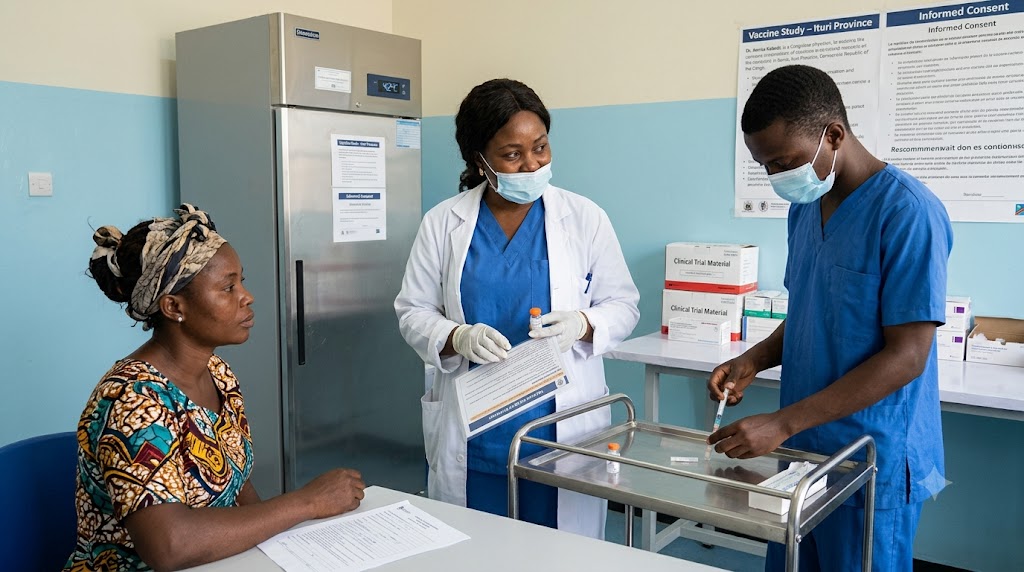
The Democratic Republic of the Congo has launched a major clinical trial to evaluate potential vaccines against the Bundibugyo strain of Ebola, marking a significant step in the country’s response to its devastating outbreak.
The trial, named Tumaini, meaning “hope” in Swahili, began on October 23, 2026, when the first participant received a vaccine in Bunia, the capital of Ituri Province, one of the areas at the centre of the outbreak.
The study will initially evaluate Ervebo, a vaccine already approved for a different Ebola strain, to determine whether it can provide protection against Bundibugyo virus. Researchers plan to assess additional candidates developed specifically for this strain, including candidates from Moderna and the University of Oxford in collaboration with the Serum Institute of India.
There is currently no approved vaccine specifically for Bundibugyo virus. The trial will examine vaccine safety, immune responses and effectiveness, using a ring-vaccination approach that prioritises people at higher risk through contact with infected individuals.
The initiative is led by Congolese health authorities and supported by the World Health Organization, the Coalition for Epidemic Preparedness Innovations and other research partners. The Institut National de Recherche Biomédicale and the University of Antwerp are co-leading the study.
The outbreak has caused thousands of confirmed cases and deaths, putting significant pressure on healthcare services. Researchers hope the trial will produce reliable evidence to guide vaccination decisions and improve preparedness for future outbreaks.
Although the trial offers an important new avenue for research, its effectiveness is not yet established. Public health experts stress that continued surveillance, community cooperation and timely access to medical care remain essential while the research proceeds.
Comments (0)
Sign in to join the conversation.